Read About Our Favorite Books For Caregivers & Children
*We do not have sponsorships. This is an entirely free podcast and resource. We simply share positive experiences we have had with books below. None of the links are affiliate links.
PARENTING BOOKS
Simplicity Parenting – Kim John Payne

I LOVED this book. I, like I think most people, get pretty overwhelmed by the amount of “stuff” in our house. I do not like a lot of clutter and I am aware of that. I also see no reason to get rid of books, basically ever. This book not only explained WHY having too much stuff in your house is overwhelming for the family; it also explained HOW to start paring down. I finally went through our toys and got rid of a TON of our toys that I felt like we had to keep. Once I went through everything (while the kids were sleeping) not one of those toys has been inquired about. I paired down our books, and put the majority of the remaining books in a closet. We will rotate them out, but this book explained why it is important to do this, even with books, and gave me the tools on how to do this.
I also like this book because it explains why starting sports early in childhood, or having a lot of “activities” is not only unnecessary, but counterproductive to the goal (enriching a child’s skills). This book emphasizes the importance of play, especially within a certain age range, and makes toy recommendations based on longevity & simplification. Kim goes into detail about how play, including unsupervised free play, is the best long-term strategy for kids learning/development.
Payne also details the importance of having a predictable rhythm to your day, and even your weeks. I appreciate that he explains how many of us are really focused on giving kids CHOICES, but it’s not generally helpful or necessary. We give TOO MANY choices and it is overwhelming for our children. From clothes, to books, to toys, to what to eat – it becomes very overwhelming for the kids to make all of those choices. He gives practical tips on even simplifying meals through the week, why this is important, and how simplifying these practices can make special occasions actually feel special!
Overall, I cannot rave about this book enough. I loved how Kim linked the overwhelming amount of choices in our current culture, to the struggles many children have with behavior. Between enrichment classes, racing to all sorts of classes, homework, excess toys, tons of clothes, unpredictable meals, etc our children have less time to just be kids, and it shows!
No Drama Discipline – Daniel J Siegel, M.D. & Tina Payne Bryson, Ph.D.
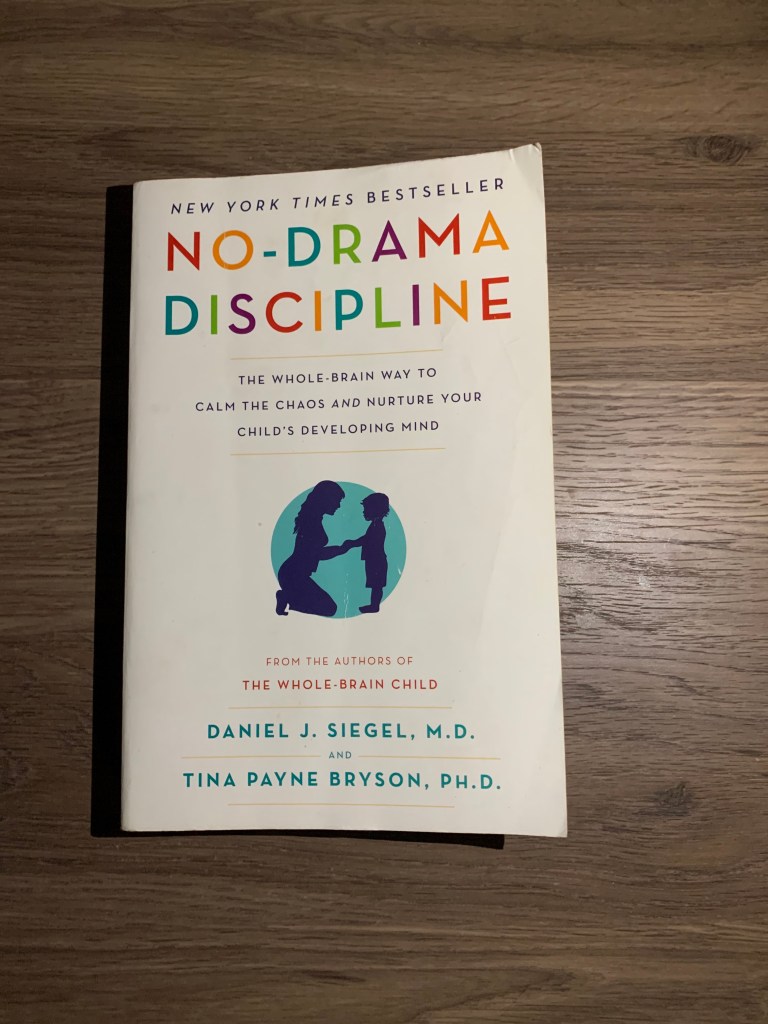
This book really introduced me to the concept of children being children. I know this seems silly, but this solidified for me that I cannot expect a child to have rational/reasonable thinking and to manage their emotions. Many adults cannot manage their emotions so it seems unrealistic that a child will be able to. In the beginning of this book they discuss that “discipline” comes from the word “disciple” which is a person who teachers. Discipline is to teach. It does not mean to punish, which is how many of us interpret the word. This simple reframe alone has helped me when it comes to holding boundaries for my child. While I am human, and have emotions, I have learned to feel less angry and explosive when my children are pushing boundaries, and instead calmly hold boundaries.
This book came after their book The Whole Brain Child. In this book they briefly describe the upstairs brain and downstairs brain. My interpretation was that when children are stressed out and, let’s say we yell at them for doing something “bad”, they are not receptive. Our yelling is not sticking because their receptive brain has shut down. If we hold our boundary calmly, then have a discussion later when they are feeling connected, they are more receptive to what we are saying. As an adult with a fully formed brain, this happens to me as well. I shut down when someone is being hysterical and I am not receptive to what they are saying. Why would I expect my child to have a more rational reaction? The book encourages you to ask Why, What, & How. Why did my child act this way? What lesson do I want to teach? How can I best teach this lesson? There are a lot of realistic applications to their methods, and reminders on how to connect and teach. This book has been helpful for our family in learning how to parent our children instead of reacting to them and ending up in cyclical behaviors.
Siblings Without Rivalry – Adele Farber & Elaine Mazlish
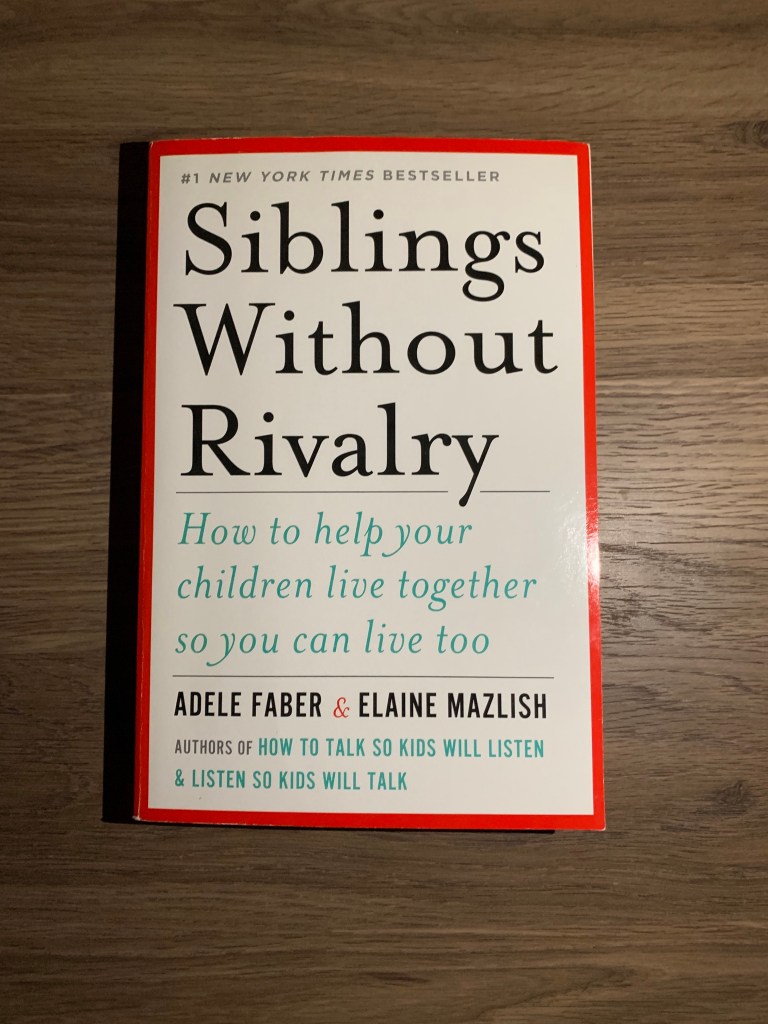
I loved this book when it comes to sibling rivalry. There will always be some dimension of sibling rivalry, no matter what. This book was so simple to read and understand. The format was different subjects tackled through an in person class, written into digestible chapters. I read the book beginning to end; however, if there is a particular issue your children seem to be fighting over you could skip to that chapter easily. In the book, the authors discuss most of the objections a parent may have to the terminal uniqueness of their children, and helps parents navigate those scenarios. My favorite part of the book is the scripts that it gives you for both children involved in any incident. The book discusses how important it is to NOT have labels for children, regardless of whether you think these labels are positive. Even a positive label puts pressure on that child, and can breed resentment in the sibling. The book also offers ways to empower a child who may be receiving the brunt of lashings from a sibling. This taught me to both remind my children of the expected rules in our house, as well as teach them to stand up for themselves. Instead of saying “leave your brother alone” we say “I see that he does not like that. X, if you do not like that say to Z ‘stop, this is my body!’” While decreasing problematic behavior is a goal, I like that this book teaches how to foster a positive relationship between siblings & empowers both siblings to both respect each other, as well as stand up for themselves.
Free Range Kids – Lenore Skenazy
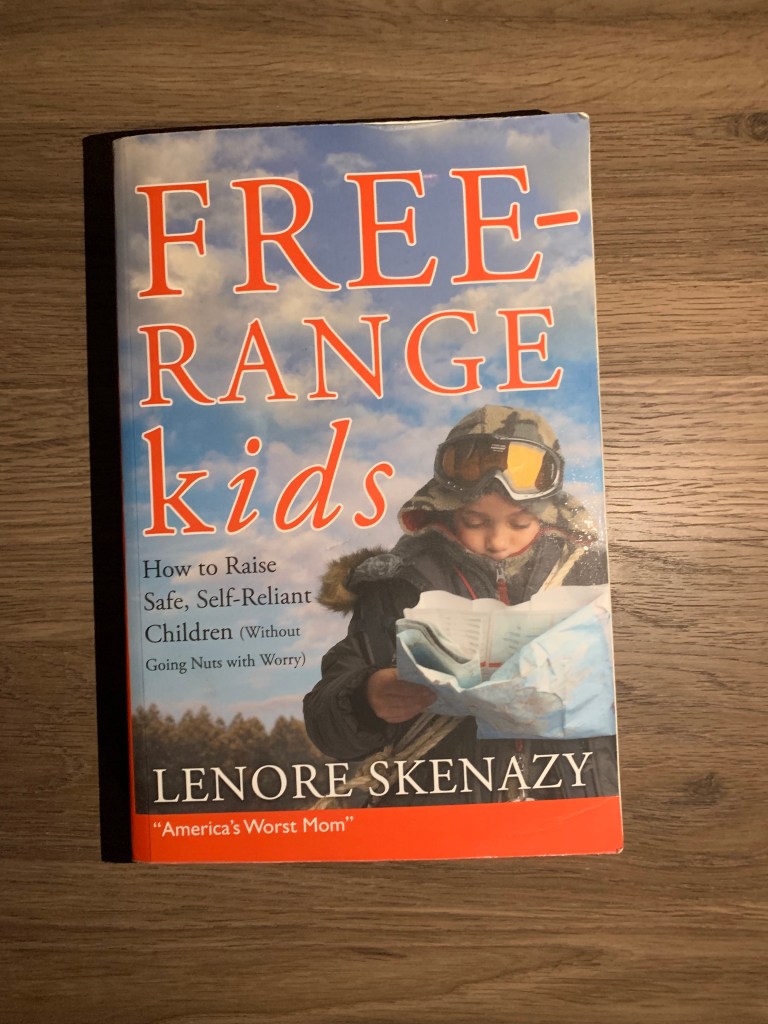
First of all, we did a whole podcast episode on this, and Armchair Expert actually interviewed Lenore Skenazy, so you can listen to both of those by clicking the underlined text. That’s how much I LOVED this book. As someone raised in the 90s, who was essentially a latchkey kid, I often feel overwhelmed by how on top of my kids I am expected to be. Though the world is actually MUCH safer for children now than it was when I was growing up, the increasing social pressures to watch my kids like a hawk became overwhelming. This book gave my brain what it needed: data. This book is super simple to read, has a lot of hilarious wit, and lots of statistics showing that the reality of our fears (children being abducted by a stranger, etc.) are much lower than we act. One of her more popular quotes from the book is, “If you actually wanted your child to be kidnapped and held overnight by a stranger, how long would you have to keep her outside, unattended, for this to be statistically likely to happen? About 750,000 years.”
I also love that she does not shame today’s parents through the course of this book. She certainly points out the flaws in the logic that many of us carry, but she is berating about it. She simply points out what many of us are led to believe, then uses data and statistics to remind us how unlikely it is for many of these scenarios to happen. This book has certainly shown a way for me to offer my children more independence and empower them to have the grit and critical thinking skills they will need as an adult. She also discusses how many of us drive our children to school so they will get their safely, and that statistically they are more likely to get injured in the car going to school than they are walking to school.
Of course, our biggest barrier right now is our society as a whole. You may choose to let your child walk to the playground alone at six, but if someone calls the cops because they believe this is dangerous, you are the one who suffers. She has a website to help spread practical skills through schools and communities. I loved this book so much and hope you will love it too!
The Explosive Child – Ross W. Greene Ph. D.
This book was a game changer for me. Upon first reading I was initially concerned that I would not be able to apply this to younger children, but it truly is still applicable. My biggest take away from this book is “kids do well if they can.” This lens change has really helped me when it comes to big and small power struggles. Something as simple as school work, I am able to see it in a whole new way, and remain calm when my child is not completing things the way I expect. When kids are acting out or having really challenging behavior, it is not because they want to drive us crazy. It is because there is an underlying reason and it is our job as the adult to dig and learn what is happening. Then, we can collaborate with the child to come up with a solution that works for both parties. At first this sounds like more work for the adult, but if digging and collaborating means less outbursts and better communication, that seems like less work overall.
This book walks you through different scenarios and helps you learn how to drill (to the core of the problem), break down problems into manageable sizes, how to connect with your child, and how to lay out concerns for both parties, how to collaborate and create a plan that meets the needs of all parties, and how to come back together to reassess if the plan is working. This book also helps you prioritize the issues you are running into with your child. I especially appreciate that this book is made for parents AND schools. The system in this book can also work for adults interacting with other adults. It truly is applicable across the board, and is an important read for parents, especially parents of a neurodiverse child.
Cinderella Ate My Daughter – Peggy Orenstein

This book was written in 2011 and is still really important now, in my opinion. Orenstein brings us through the history of the princess hysteria, pointing out the origin of “The Disney Princesses”. She also reminds us of the arbitrary gender roles associated with color, and how it all began as a clothing marketing campaign. What I appreciate most about this book is that, again, Orenstein is not shaming ANYONE for being caught up in princess culture, or their daughters being caught up in it. She is simply pointing out the culture itself, and she points out that it is not quite as innocent as we are letting ourselves believe it is. Letting our children be indoctrinated into the princess world at a young age is one way we are hypersexualizing girls and making their worth about their appearance. She also discusses what it is like to be the odd man out on this subject when she is with a group of other mothers, and finding the balance between her daughter being able to partake in the princess pink explosion without it being an all-consuming aspect of her identity. I have sent this book to friends who have little girls. If nothing else, it simply makes you more aware of what you are introducing to your children.
FICTION BOOKS
The Nightingale – Kristin Hannah
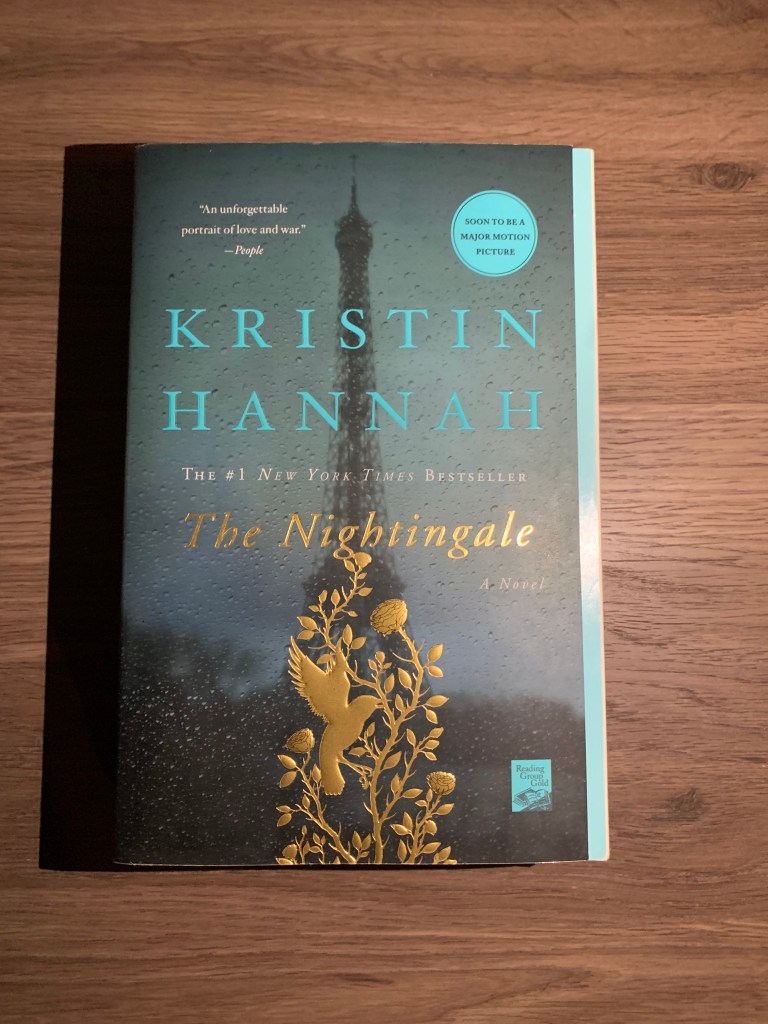
My heart broke into a million pieces when I finished this book, and honestly, I am still mourning the loss of the characters. This book is about two sisters in France during the Nazi invasion. Both sisters take their stance, though in drastically different ways. One sister flees the small village they live in to help bring others to freedom. The other sister stays in her home in the small village, and ends up having to let a Nazi live with her. Of course, you become sympathetic to this Nazi, and to both sisters. There is a bit of a romance story, though it is not the main theme of the book, and one of the sisters ends up in a concentration camp. There is so much heartbreak and heroism in this book, and of course I love that the two main characters are women!
 Momosas